Skip to content
Vegas Retold

The history of The Venetian Resort Las Vegas

Opened May 1999

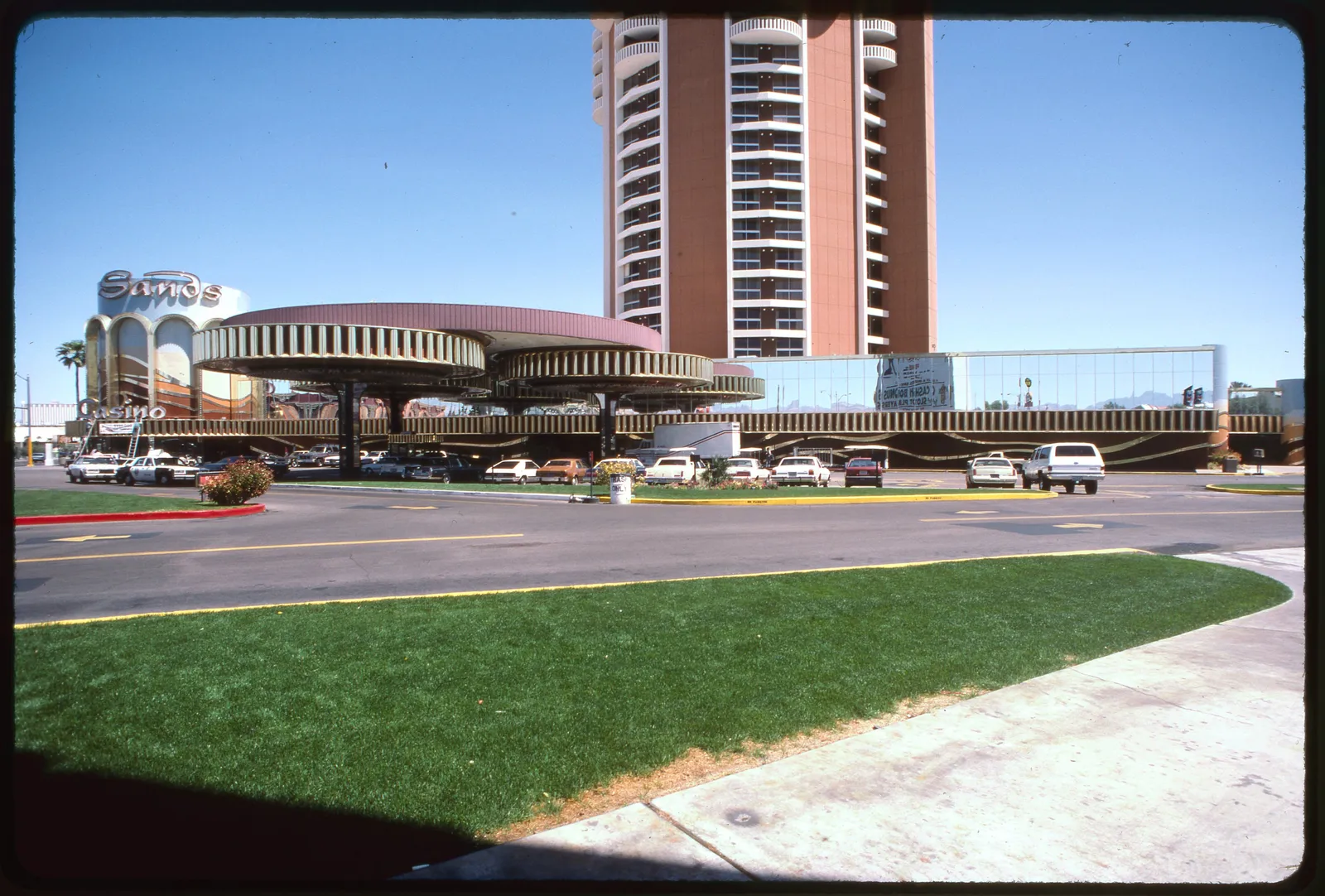
The Sands entrance canopy and sign beside its tall hotel tower, seen across the street.
The Sands entrance and tower on April 20, 1987, before its demolition and replacement by The Venetian. This photograph shows the predecessor resort.

André Corboz / USI Iconoteca / Wikimedia Commons, CC BY-SA 4.0

Image source· License

Original photograph reproduced without editorial alteration; responsive overview and index display may crop the presentation.

The Venetian opened in May 1999 on the site of the former Sands hotel. Its canals and Italian landmarks announce one part of the story; the convention centre explains another. Sheldon Adelson bought the Sands in 1989, and the adjacent Sands Expo opened in 1990, before the old hotel was demolished in 1996. The Venetian brought a new hotel, restaurants, shopping and entertainment into that business-travel setting. This sequence matters: the convention business was already established before the Venice-themed resort arrived.

A new resort on the Sands site

The old Sands and today's Venetian share a site history, but the Venetian is a replacement resort rather than a renamed surviving Sands hotel. Las Vegas Sands' retrospective dates the opening festivities to May 3, 1999; contemporary reporting and company financial material also use May 4. May 1999 is the common ground, and the date field here deliberately preserves that month-level precision.

Why Venice?

The resort's own origin account connects its Venetian theme to Sheldon and Miriam Adelson's honeymoon in Venice. That is the operator's explanation of the inspiration, not evidence that the Las Vegas buildings are historical Venetian structures.

Italian craftsmanship in a Las Vegas setting

The architecture rewards attention to materials as well as silhouettes. The resort describes Italian artists painting its ceiling frescoes, solid Botticino-marble columns in the main colonnade and a fitted marble floor patterned after the Church of Santa Maria del Rosario. These are modern acts of copying and craftsmanship: the interest lies in how a new Las Vegas resort translated a distant city into an immersive hotel and shopping environment.

Business travellers and leisure visitors

The canals, colonnades and meeting spaces also reveal two audiences being served together. A visitor might encounter the property as a theatrical version of Venice; a convention delegate might use it as an interconnected place to work, sleep, eat and spend an evening. Las Vegas Sands' history explicitly presents the combination of business and leisure as its integrated-resort model. Later expansion joined The Palazzo to the wider complex.

The 2022 sale

A further change came on February 23, 2022, when Las Vegas Sands completed the sale of The Venetian, Palazzo and Venetian Expo to Apollo and VICI affiliates. The transaction separated the operating business from the real estate: Apollo-affiliated funds acquired the operations while VICI acquired the land and real-estate assets. The familiar resort name continued through that ownership change. A useful history therefore keeps three things apart: the lost Sands hotel, the 1999 Venetian development, and the larger resort and convention business operating under the Venetian name today.

  1. Las Vegas Sands: The Venetian and the integrated resort

  2. The Venetian: Resort history and architecture

  3. Las Vegas Sun: contemporary opening report

  4. Las Vegas Sands: completion of Venetian sale

  5. Las Vegas Sands: 2002 annual report

  6. VICI: Venetian acquisition completion (2022)

  7. Mapcarta: The Venetian Resort Hotel Casino site

What remains uncertain

  • Opening sources distinguish May 3 festivities from May 4 accounts of the resort opening. The recorded date is May 1999 rather than a falsely definitive day.
  • The operator's honeymoon account is attributed as its origin narrative. Current entrance, attraction and event arrangements require a separate operator check.

This site through time

Shared or overlapping site with The Palazzo Las Vegas

December 30, 2007

The Palazzo was built north of and directly connected to The Venetian, adding another hotel tower, casino, shops and dining to the wider resort and convention complex. Its partial opening in December 2007 and hotel opening in January 2008 followed The Venetian’s 1999 opening. These are connected parts of a larger resort site, with distinct buildings and opening histories; Palazzo did not rename, renovate or replace The Venetian.

Historical source — Las Vegas Sands fiscal2007Form10K,Operations/LasVegas, paragraphs202–205:Palazzo partialDecember30opening,northofVenetian/directconnections toVenetian/Expo/CongressCenter. Fiscal2008Form10Kline1964confirms suites followedJanuary2008. Currentoperatorresort pages still identify Palazzo withinTheVenetianResort.

  • Shared resort site means an integrated connected complex, not identical casino footprints or the same hotel tower.
  • The Palazzo’s partial resort opening and later public hotel suites are separate milestones.
  • The older Sands site under The Venetian should not be equated with every part of the later enlarged complex.

Replaced Sands Hotel and Casino

1996 – 1999

The Sands hotel and casino closed in 1996 and was demolished to make room for The Venetian, which opened in 1999. This was a new resort on the former Sands site, rather than a change of name for the existing hotel.

Historical source — The Beginning: Sands imploded in 1996 to make room for The Venetian. Las Vegas Strip Debut: completed and opened in 1999. Corroboration: UNLV Sands Hotel Public Relations Records MS-00417, Biographical/Historical Note, closure June 30, 1996 and implosion November 26, 1996 (https://special.library.unlv.edu/ark:/62930/f1mw5j).

  • The relationship describes site succession; it does not claim that the two resorts had identical building footprints or boundaries.
  • The year range marks demolition and replacement opening, rather than the operating dates of either property.
Suggest a correction or source