
The Sands opened in December 1952 as a low-rise Strip resort whose entertainment became part of Las Vegas's public identity. UNLV's archive names Jake Freedman and nightclub impresario Jack Entratter among its developers and attributes the design to Wayne McAllister. The Copa Room brought Frank Sinatra, Dean Martin and Sammy Davis Jr. into the property's story.
From low-rise hotel to tower
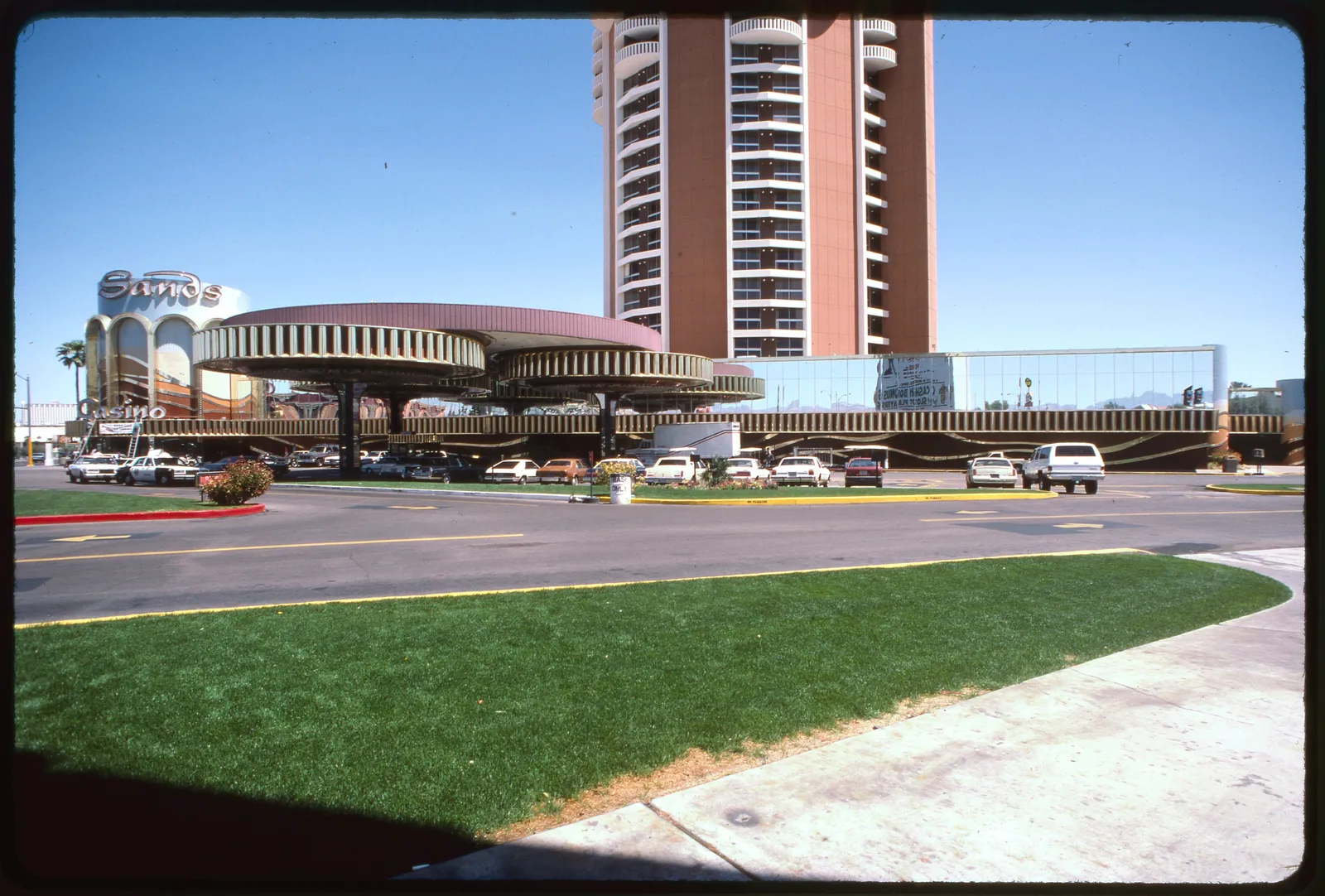
After Freedman's death in 1958, Entratter and casino boss Carl Cohen became president and vice-president. The buildings changed as well as the management. Construction of a circular hotel tower began in 1963, and Howard Hughes acquired the resort in 1967. The familiar Sands of later photographs was therefore an expanded property, rather than the opening-day collection of low buildings.
What the signs reveal
Its signs reveal that change particularly clearly. The Neon Museum describes the original 56-foot sign towering over the hotel wings, with its oversized script lettering announcing the resort. Readerboards were added to advertise the acts inside. A later redesign under new owners in 1981 reduced the prominence of the name and devoted much more space to changing messages. The tower could now identify the hotel from a distance, while the sign sold its current entertainment. Compare that history with André Corboz's 1987 photograph in the history section: the frontage and tower belong to the Sands' later life.
The convention business
A renovated casino reopened in January 1982, and the property subsequently passed through further ownership changes before Sheldon Adelson's company developed a different future for the site. The Sands Expo and Convention Center opened in 1990. Convention business would become a central part of the replacement resort's identity, linking a much larger development to the older site's name.
Closure and replacement by the Venetian
The Sands closed on June 30, 1996. Its hotel was imploded on November 26 that year. The Venetian, completed in 1999, replaced it on the former resort site. This was redevelopment after demolition, rather than a rename of the Sands buildings. The Venetian's own history describes the removal of the Sands to make room for a resort inspired by Venice; Las Vegas Sands' corporate chronology connects the new hotel with the convention centre that had already opened.
Those layers are useful when reading the site today. A property name, a hotel building and a convention business need not share the same lifespan. The Sands can survive in performance recordings, photographs, archives and company history while its casino resort has gone. The Venetian's present footprint should not be treated as an exact outline of the old Sands. The map on this page marks the vicinity of the documented historical address, with the approximation stated explicitly.