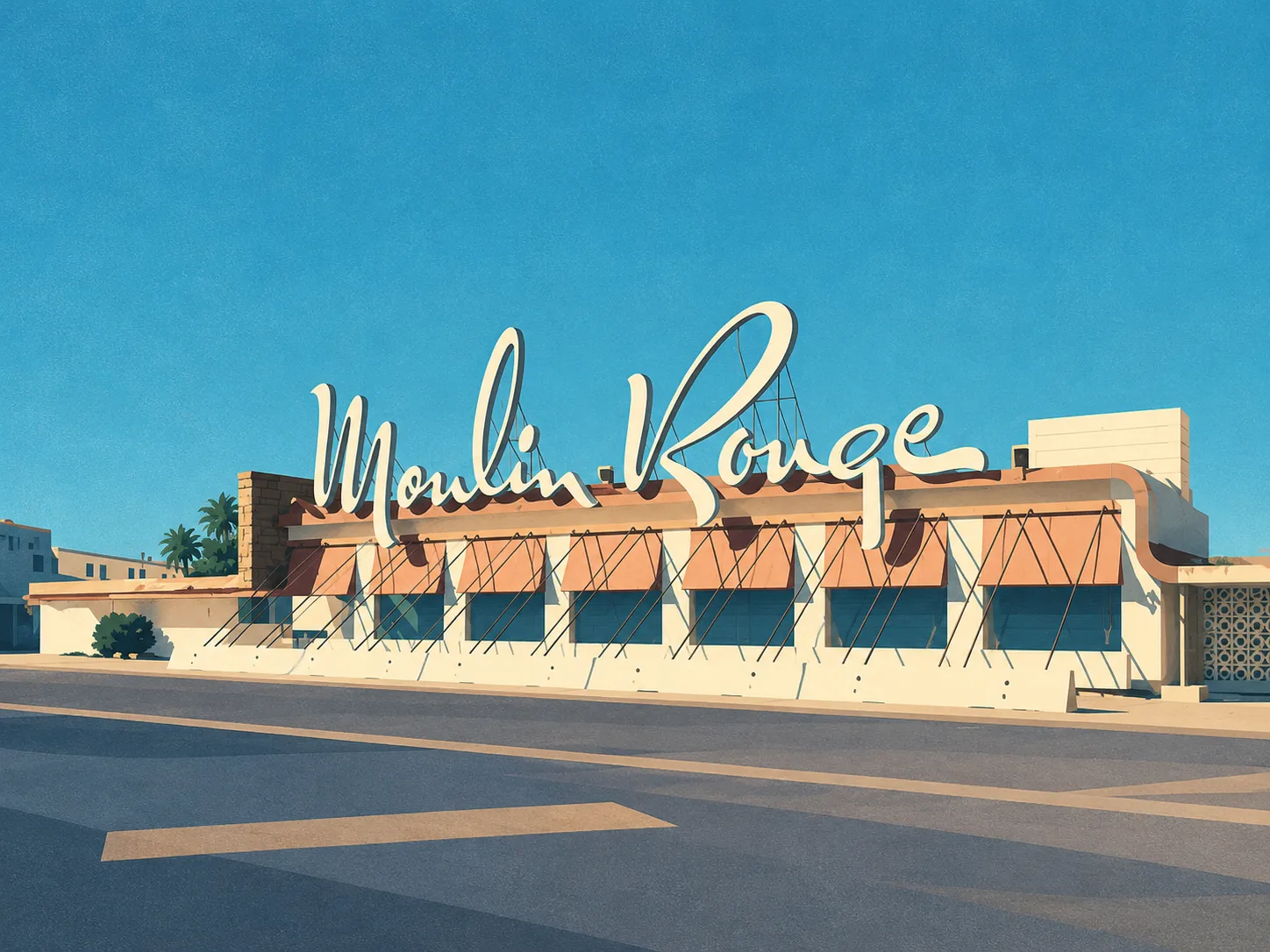
The Moulin Rouge opened on May 24, 1955, on Las Vegas's Westside, offering a hotel, casino and entertainment venue where Black and white guests could mix. That mattered in a city whose major resorts routinely barred Black customers, including entertainers who appeared on their stages. The Nevada State Museum records former heavyweight champion Joe Louis as the casino host and describes mixed crowds attending the opening show.
Building an integrated resort
The project had begun in 1954 with investors including restaurateur Louis Rubin and developer Alexander Bisno. Architects Walter Zick and Harris Sharp designed the complex. Its hotel wings and entertainment spaces made integration part of an entire resort operation, rather than a single performance or private gathering. The city's history also emphasizes the visible jobs available to Black workers, including dealers, bartenders and managers.
The original closure
The original run ended in October 1955. The National Register nomination describes financial pressures, receivership and competing explanations for the failure. Popularity and a famous guest list did not ensure a stable business. The evidence supports a short original operation; it does not justify treating a single rumored cause as settled fact.
The name nevertheless outlived that season. Later management and uses returned to the property, and its most consequential meeting took place after the original resort had closed. A closure date for the 1955 operation therefore describes one chapter in the site's history, rather than the disappearance of every building or later use.
The 1960 agreement
On March 26, 1960, Black community leaders, including NAACP president Dr. James McMillan, met hotel operators and public officials at the Moulin Rouge as a protest march against segregation was planned. The National Register records Governor Grant Sawyer's participation and an agreement by most operators to admit Black guests. The march was canceled. The city distinguishes this advance in dining, gaming, shows and accommodation from continuing barriers to front-of-house employment.
The site and the surviving sign
The buildings' later history is a separate story of loss. Fires damaged the property in 2003 and 2009; the façade and tower were demolished in 2010. The city's account records further fires and demolition of remaining structures in 2017. The large cursive sign survived through removal to the Neon Museum. The historic casino site on West Bonanza Road and the museum's relocated sign are different places.
The surviving photographs and the 1992 National Register nomination preserve details that the demolished complex can no longer show. Read the nomination's descriptions of intact rooms and buildings as observations from that earlier survey. The illustration here depicts the later closed frontage and sign from a supplied photograph, rather than a present-day building or the 1955 opening. Together, the resort's brief integrated operation and the later civil-rights meeting explain why its importance extends far beyond the length of its original casino business.