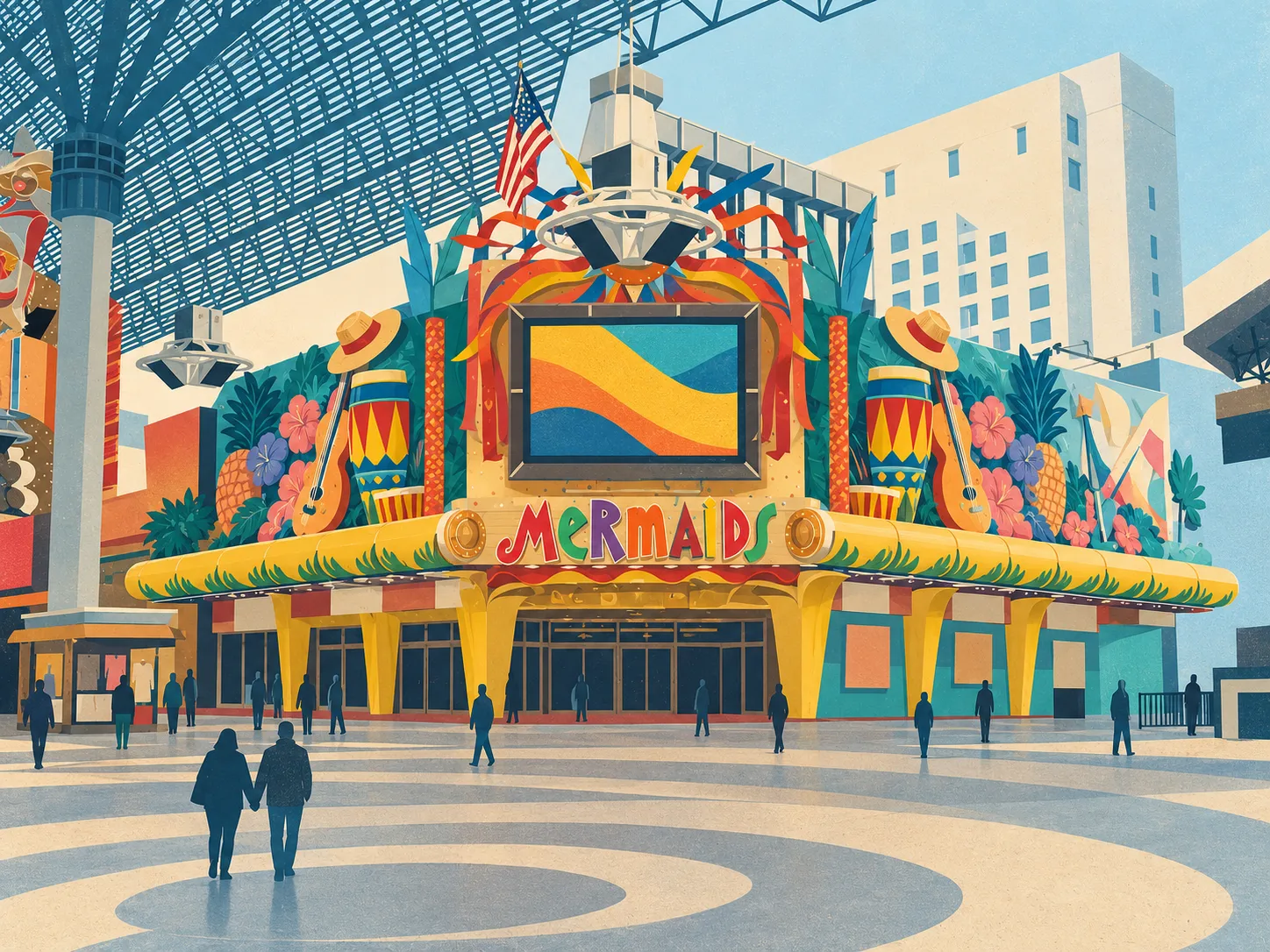
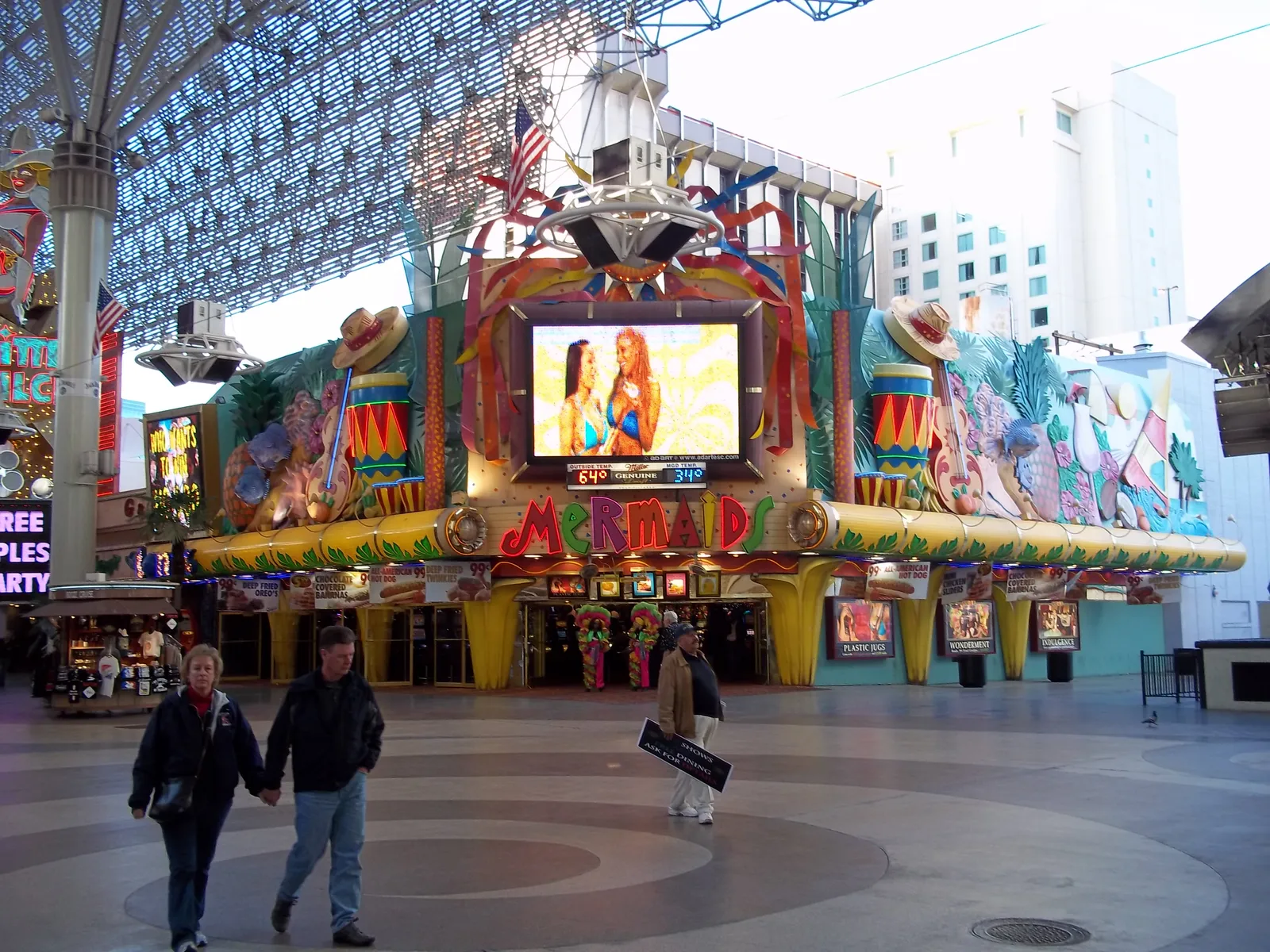
Mermaids was a small casino at 32 Fremont Street, near First Street, remembered for a tropical frontage, daiquiris and a snack bar serving deep-fried Twinkies and Oreos. It had no hotel or table games in its final years. Its scale and street-facing entrance made it a different kind of stop from the casino hotels around it.
Earlier names at the corner
The corner had a longer gambling history. Pam Goertler’s collector research traces earlier casinos at the address through Silver Palace in 1956, Carousel, Gambler’s Hall of Fame, Sundance West and Sassy Sally’s. Sundance West here was distinct from the Sundance hotel farther east that later became Fitzgeralds and The D. The earlier names do not, by themselves, establish uninterrupted business or building continuity.
From Sassy Sally’s to Mermaids
Goertler dates the change from Sassy Sally’s to Mermaids to 1999 and recalls its promotional photographs during a May 2000 visit. Contemporary reporting independently identifies Herb Pastor’s Mermaids by August 2000. The precise opening day under the new name remains unconfirmed. The Western decoration gave way to an island theme, while staff continued encouraging pedestrians inside.
Renewing the frontage
The frontage kept changing. The city’s fiscal 2012 report records a $60,000 improvement project at Mermaids Casino Bar, supported by a $15,000 matching grant. Repairs, a new LED screen and energy-efficient technology updated a small business beneath the Fremont Street canopy.
The final night and a larger site
Derek and Greg Stevens bought Mermaids, La Bayou and Glitter Gulch in April 2016. Mermaids closed on June 27. Reporting from its final night describes the snack-bar countdown, a last hour of slots and cocktails, and employees saying goodbye. KNPR confirmed the completed closures two days later, when Stevens discussed the possibilities opened by assembling the north-side block. La Bayou, across Fremont, belonged to a different redevelopment site.
Temporary gaming, then demolition
A brief slot-machine session at Mermaids on June 28, 2017 preserved gaming rights ahead of redevelopment. It was not a return to ordinary casino operation. By an August 5 report, the Mermaids building had been demolished. Its land became part of the larger Circa resort, whose casino opened in October 2020. This was replacement by new construction, rather than another change of name on the old casino.
Mermaids is now a historic property. The historical photograph shows its operating frontage in 2011; the approximate map point identifies its former Fremont Street site, not a current entrance or the boundaries of all the earlier casinos at this address.
Read the full history ↗ Sources and context
-
Pam Goertler, assisted by Brian Cashman, “Fremont Street,” Casino Chip and Token News, Fall 2006, printed pages 41–43/PDF indices 10–12. Collector research on the earlier names at 32 Fremont; firsthand recollection of the change from Sassy Sally’s and a May 2000 promotional photograph. Dates for some other casinos in this article conflict with contemporary evidence and are not adopted.
-
August 28, 2000 report identifies Herb Pastor’s Mermaids and La Bayou as operating casinos. This independently establishes use of the new name by that date; lawsuit allegations are not treated as findings or repeated here.
-
City of Las Vegas Economic and Urban Development, Fiscal Year 2012 Year In Review, printed page 16/PDF index 23, “Mermaids Casino Bar”: 32 Fremont Street, $60,000 project, $15,000 Visual Improvement Program grant; repairs, a new LED screen and energy-efficient technology. Later legislative exhibit date is not the renovation year.
-
J.D. Morris, June 27, 2016, interviews with general manager Rudy Nino and Derek Stevens. No hotel or table games; snack bar, daiquiris, April sale and distinct north/south Fremont sites. Morning report gives a planned closing hour, distinguished from the following night’s eyewitness account.
-
Kristen Peterson, June 28, 2016; firsthand final-night account and Mikayla Whitmore image caption identify June 27 closure at 11 p.m., snack-bar countdown, final slot/cocktail hour and employee farewells. Indexed full article text read; direct web-reader fetch unavailable. No image permission inferred.
-
Doug Puppel, June 29, 2016, programme webpage text with Derek Stevens interview: completed Mermaids/La Bayou/Glitter Gulch closures and assembled north-side block for a future hotel project. Audio not heard.
-
Scott Roeben, July 16, 2017, firsthand account of temporary slot sessions June 27 at Las Vegas Club and June 28 at Mermaids to maintain gaming rights. Its erroneous Las Vegas Club June 2016 closure is rejected; this is a historical event, not current legal guidance.
-
Scott Roeben, August 5, 2017, original on-site demolition report confirms the Mermaids building gone and notes excavation at the former lower-level restaurant. Plans in July are not treated as completion dates; no exact demolition day asserted.
-
Operator’s December 28, 2020 release retrospectively confirms October 28 casino/public-amenity opening and the later hotel tower/Legacy Club completion. Circa is a larger replacement development, not a Mermaids rename.
-
December 7, 2014 change, unnamed building way 316174409 version 1, north of Fremont near First Street. Exact dated node geometry read through the public API; representative point 36.17150,-115.14530 is inside. Association with Mermaids uses the City’s 32 Fremont address and the 2011 frontage photograph. Approximate site, not a cadastral boundary.
The exact opening day under the Mermaids name is unconfirmed. The 1999 date is attributed to collector research and the name is independently documented by 2000.
Dates for some earlier casino-name changes differ among accounts. This entry does not assign every earlier name a precise year or infer continuous ownership and surviving walls.
The temporary June 2017 slot session was distinct from the June 2016 end of ordinary operation; no current licensing rule is asserted.
The former-site marker is approximate. The 2014 mapped building is unnamed, and its association with Mermaids relies on the address and frontage evidence; it does not establish a complete cadastral footprint.