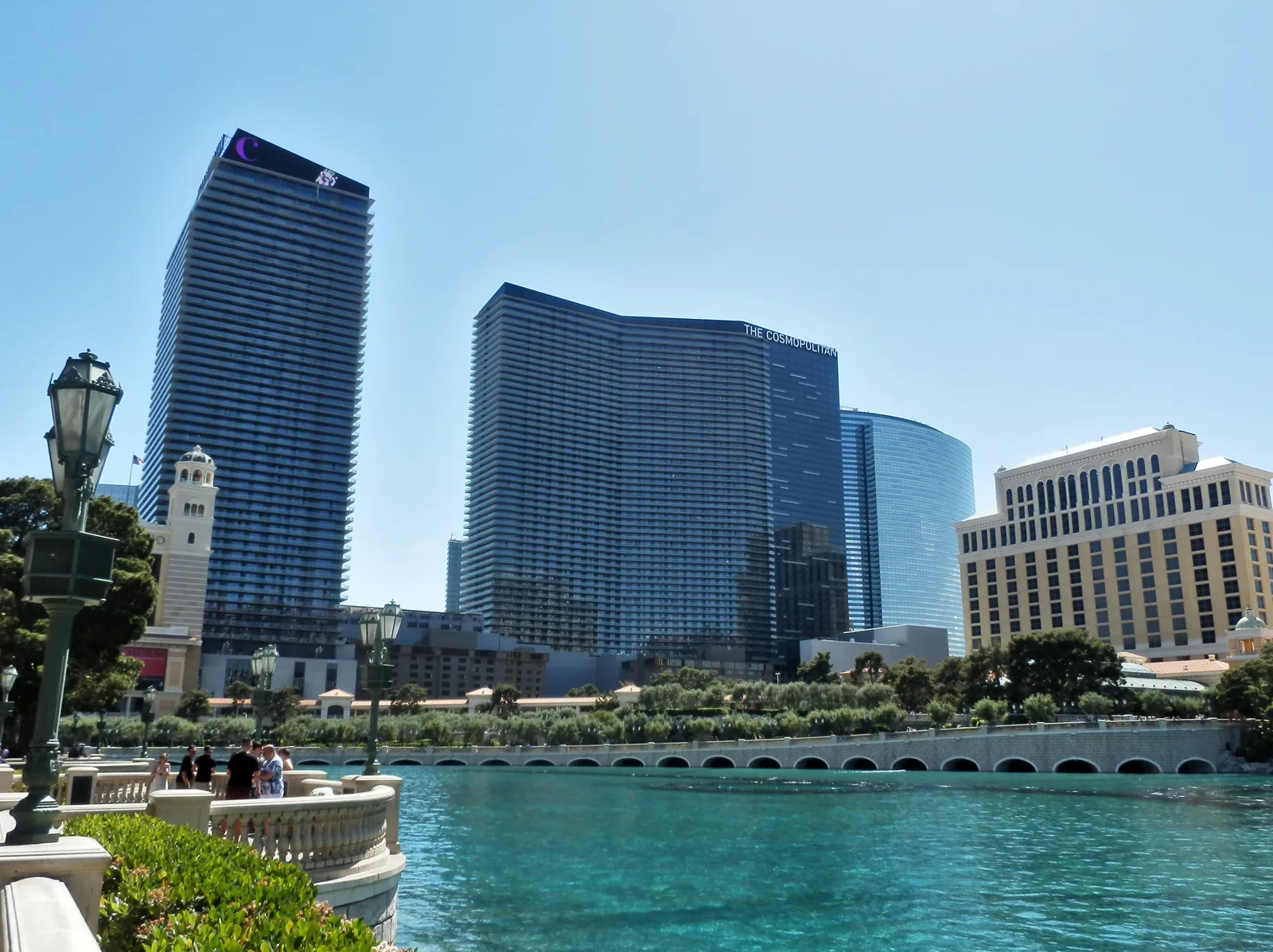

The Cosmopolitan of Las Vegas opened to the public on December 15, 2010. Its two balcony-lined towers brought a different silhouette to a compact site between Bellagio and CityCenter. Contemporary architecture, terraces and stacked hotel, casino and entertainment spaces gave the resort an identity built around the city rather than a replica of another place.
Development and foreclosure
Its route to opening was unsettled. Development began under earlier owners, but the mortgage went into default in January 2008. A Deutsche Bank subsidiary acquired the property at a foreclosure sale that September. The resort’s first annual report documents that change while describing a hotel project still being completed in phases.
An opening in phases
The first public opening was not the completion of every room. The 2010 report identifies a first phase in December and further West Tower rooms planned for incremental completion in 2011. That distinction helps explain why later accounts and current fact sheets give larger room totals than the first opening inventory.
Blackstone’s changes
Blackstone acquired the resort in 2014 and invested in changes to its rooms, dining and other spaces. MGM’s later transaction announcement records room renovations in December 2018. The Cosmopolitan therefore continued to evolve behind its familiar towers without losing its name.
MGM takes over operations
On May 17, 2022, MGM Resorts completed the acquisition of the Cosmopolitan’s operations. The transaction separated the operating business from the real estate: MGM entered a long lease with the partnership acquiring the land and buildings. The resort continued under its own name. Its loyalty program was integrated into MGM Rewards in July 2024, a later step in joining the operator’s wider network.
The Jockey Club remains distinct
The neighboring Jockey Club also remains distinct. The opening-era filing describes a timeshare development adjacent to the Cosmopolitan, with an agreement for parking and access to parts of the new resort. Physical proximity and shared facilities do not make it an earlier Cosmopolitan casino or a demolished predecessor.
The resort and photograph today
The Cosmopolitan remains an operating hotel-casino at 3708 South Las Vegas Boulevard. The operator’s current fact sheet credits Arquitectonica as building architect and Friedmutter Group as executive architects. The April 2018 photograph shows its towers behind Bellagio’s lake; Bellagio at right and Vdara farther back are separate properties. The map identifies a building area, not both towers’ complete footprint or a visitor entrance.