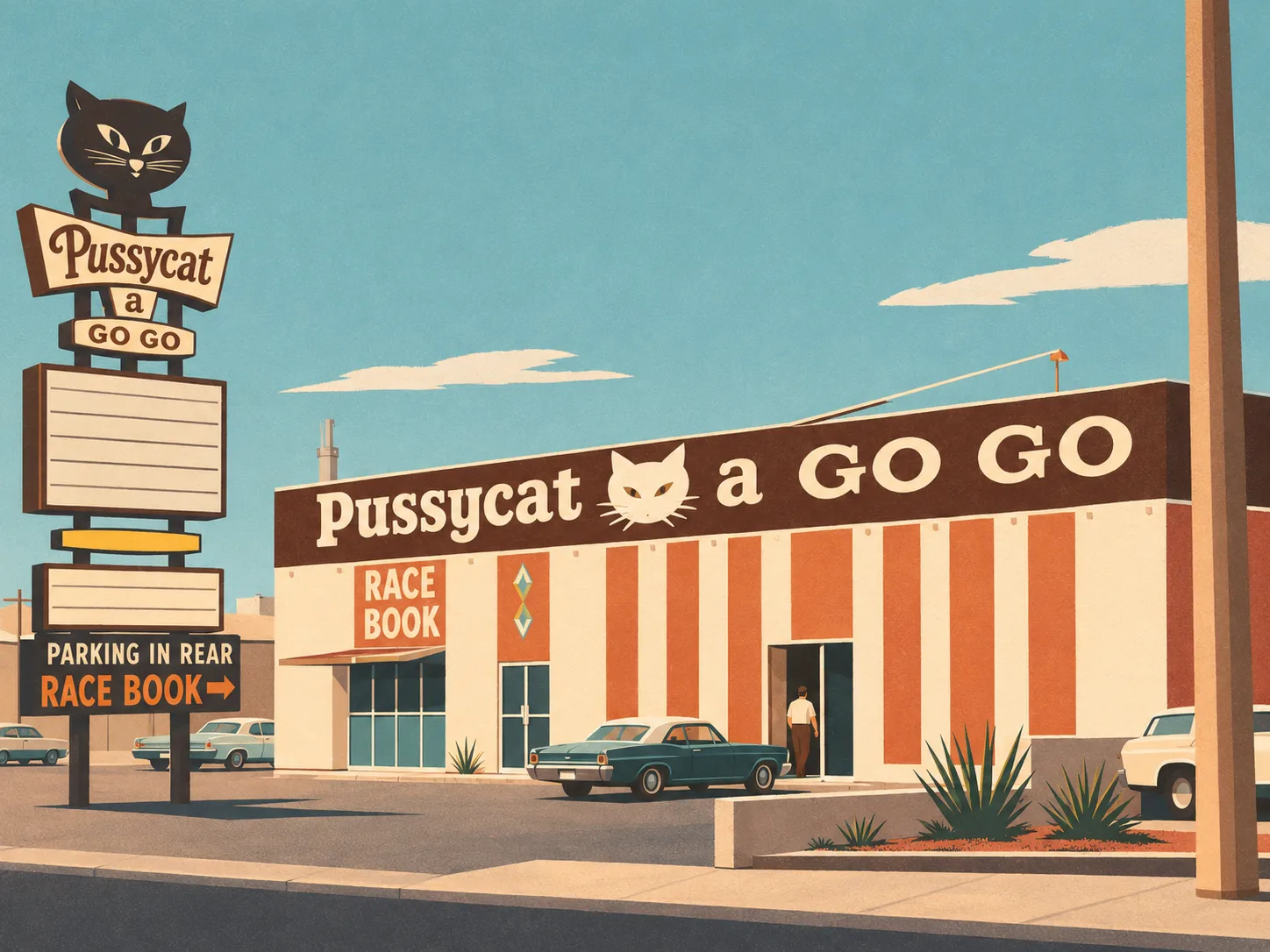
The Pussy Cat a Go-Go belonged to the Strip’s late-night music world: live bands, go-go dancers and a dance floor that drew people who had already finished their own shows. In recollections preserved by Classic Las Vegas, musicians describe the club filling after 2 a.m., when dancers, showgirls and other Strip workers arrived.
Accounts date its opening to 1964 and associate it with bandleader Garwood Van. The club offered rock and roll alongside a small casino and restaurant. Contemporary entertainment listings held by UNLV place the Check-Mates, Alan Hodges and the Nite Owls, and go-go dancers on its March 1965 bill. Decades later, Sonny Charles and Marvin “Sweet Louie” Smith recalled the Pussy Cat as the Checkmates’ first Las Vegas engagement.
The club’s story opens a different view of the entertainment city: the places performers went to hear one another, dance and spend the hours after work.
A small club can reveal connections that a history of the big hotels misses. The Pussy Cat brought working entertainers and emerging bands into the same room, linking the Strip’s showroom circuit with its rock and R&B nightlife. Surviving listings, photographs and musicians’ recollections preserve a glimpse of the city’s working music community beyond the headline acts.
Reposted participant accounts, February 15, 2019: Garwood Van, 1964 opening, bands, dance floor, small casino and after-hours crowd. Additional sources: UNLV March 1965 entertainment listing, https://special.library.unlv.edu/sites/default/files/2026-01/man002555.pdf ; Las Vegas Sun interview with the Checkmates, July 19, 2002, https://lasvegassun.com/news/2002/jul/19/columnist-jerry-fink-in-fifth-decade-checkmates-st/ ; Vintage Las Vegas, WYNN RESORT south section, https://explore.vintagelasvegas.com/strip.html ; UNLV Kenny Kerr oral history OH-01010, photograph 15, printed page 46, https://special.library.unlv.edu/ark:/62930/d1nk36f3h ; UNLV Van Family Papers MS-00825, https://special.library.unlv.edu/ark:/62930/f1qq17 . Checked November 1, 2026.
What remains uncertain
The closing date remains unresolved: ChipGuide gives September 10, 1971, while Vintage Las Vegas traces the Pussycat name into 1972 and a Chez Pussycat phase. No exact closing date is selected.
Accounts disagree about the later redevelopment site. Vintage Las Vegas places the venue in the southern part of the present Wynn site; ChipGuide and Spinetti’s identify the Palazzo. No exact footprint, address or map pin is selected.
Late-night atmosphere and the club’s internal layout come from retrospective participant accounts; they are presented as recollection.
UNLV’s Van family collection biography gives 1954 for the club’s opening, conflicting with the 1964 date in other accounts. The date is discussed in the text rather than entered as a settled date field.