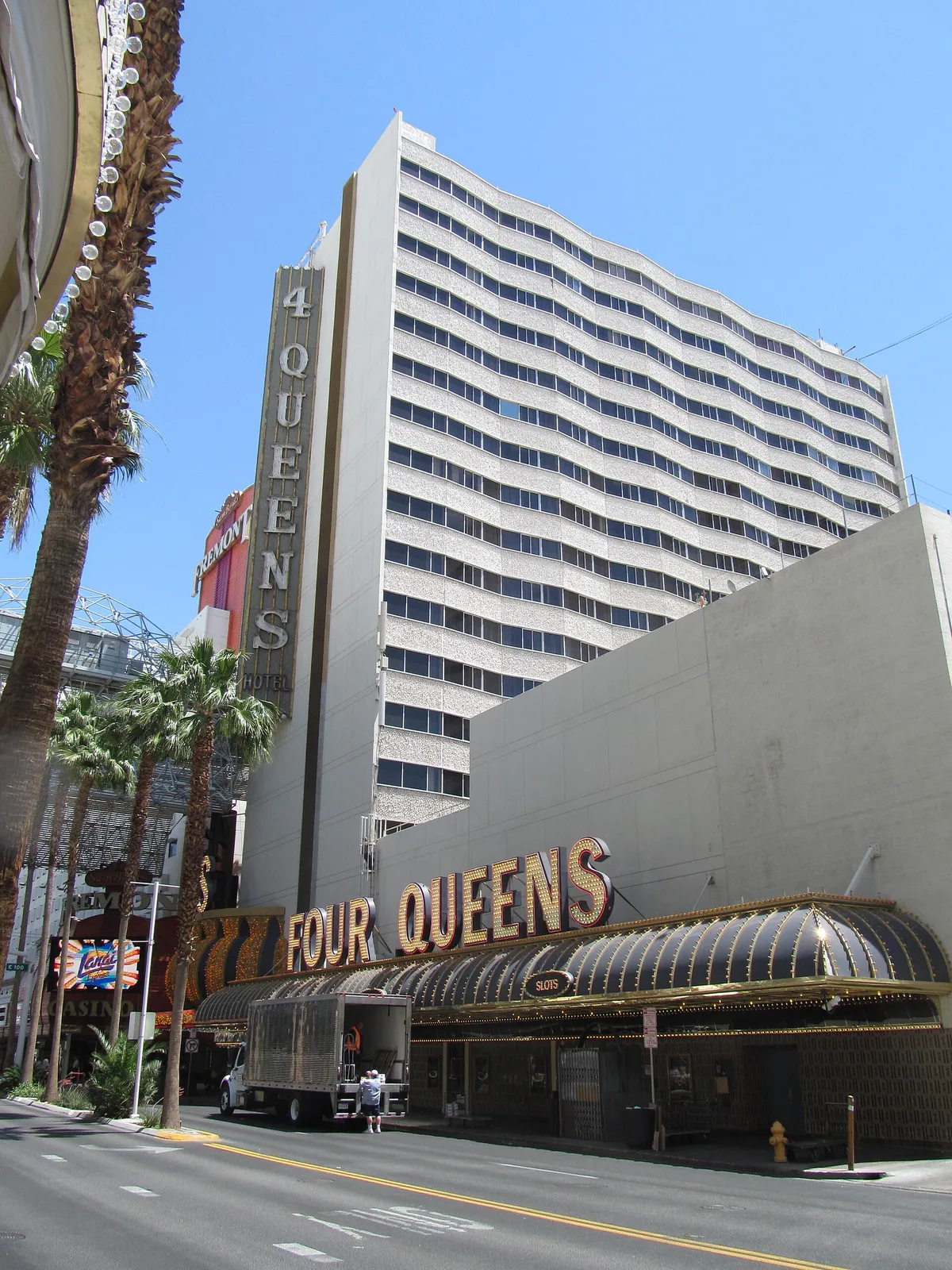

Four Queens opened its casino on June 2, 1966, at Fremont Street and Casino Center Boulevard. Its first hotel rooms followed that summer. The project began with an eight-story hotel of 115 rooms and suites, then grew through later additions into the larger Downtown hotel seen today.
The four daughters behind the name
Founder Ben Goffstein named the property for his four daughters, linking each to a playing-card queen: Michele to spades, Benita to clubs, Faith to hearts and Hope to diamonds. The name made a family association part of the casino’s public identity. Opening promotions were extravagant, with prizes that included a house and a diamond ring; the Nevada State Museum also preserves a later giveaway of stockings.
Changes in leadership
Goffstein died the year after the opening, and partner Tom Callahan took over. A later leadership change brought Jeanne Hood to the presidency after her husband David died in 1977. The museum identifies her as one of the relatively few women then leading a Las Vegas hotel and casino.
The Elsinore era
The early 1970s brought the Elsinore corporate era. Originally part of Hyatt, Elsinore became independent in 1979 and kept its headquarters at Four Queens. UNLV’s history describes bankruptcies in 1985 and 1995 as the company struggled with wider investments and debt. The hotel’s ownership story was therefore part of a larger corporate gambling business, extending beyond Fremont Street.
TLC and a Downtown sister property
Terry Caudill agreed to buy the property in 2003. Nevada’s licensing record marks TLC Casino Enterprises and Caudill’s ownership from October 10 that year. Four Queens remains under TLC, which also owns Binion’s across Fremont Street. They are sister properties at separate sites.
Renovating the North Tower
The hotel continues to change within that established identity. In August 2025, general manager Tim Lager reported completion of a $24 million North Tower renovation. The operator now describes rebuilt rooms with new plumbing and air conditioning, expanded bathrooms and sound-dampening windows. This was a renovation of the existing hotel, continuing the long-running Four Queens name at 202 Fremont Street.