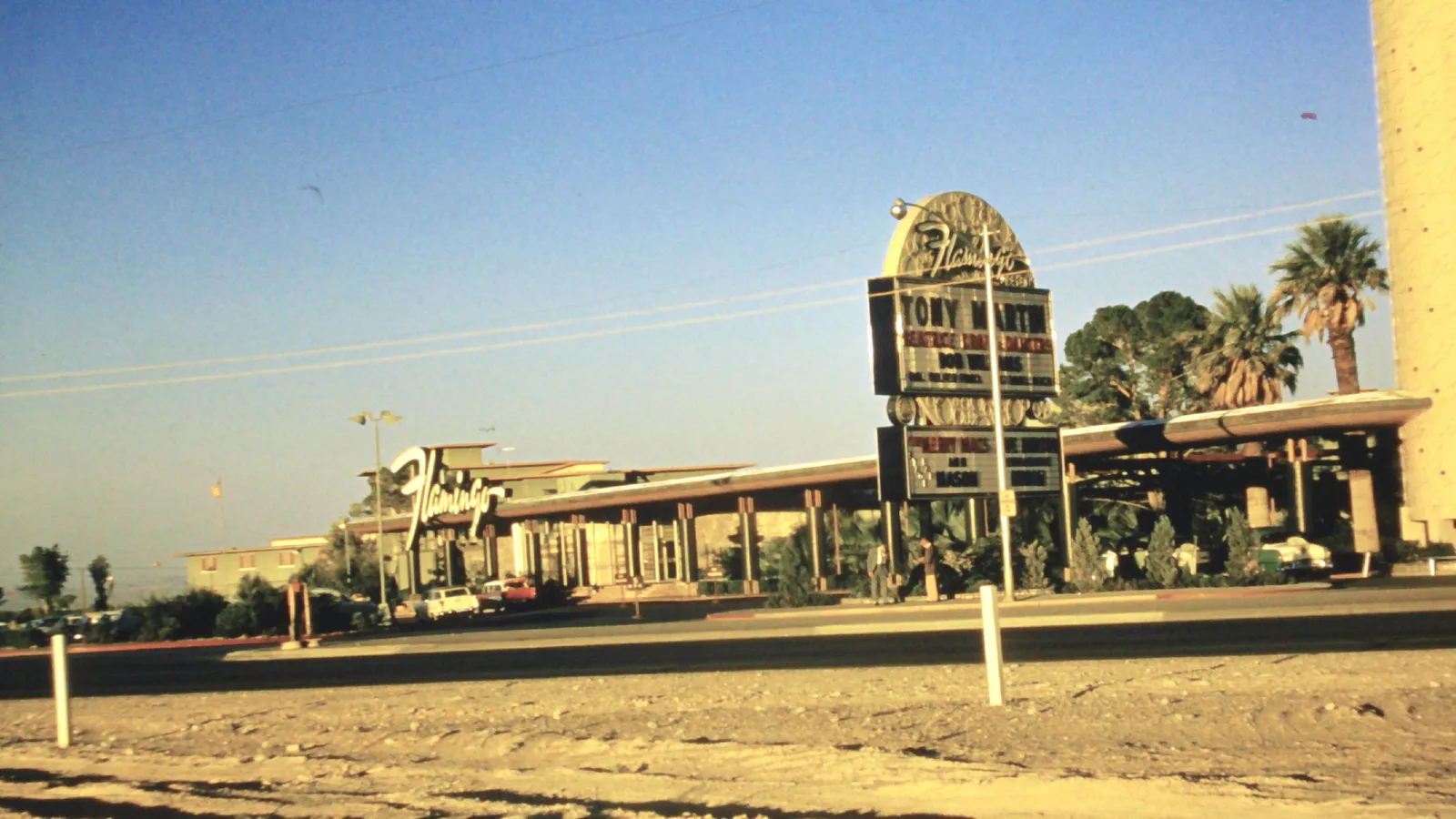

The Flamingo opened its casino on December 26, 1946, offering Hollywood glamour instead of the western imagery of the Strip’s earlier resorts. Billy Wilkerson conceived the project; Benjamin “Bugsy” Siegel became its financier and took control of its completion. Their roles should not be collapsed into a story in which Siegel alone invented the resort.
A casino before the hotel was ready
The first opening was also an unfinished one. Jimmy Durante and Xavier Cugat appeared, but the hotel rooms were not ready. Guests had to sleep elsewhere. After early losses, Siegel temporarily closed the casino while construction continued; the hotel accommodation followed in 1947. The December casino debut and the later hotel opening explain why historical accounts sometimes give different starting years.
After Siegel
Siegel was killed in Beverly Hills in June 1947. The Mob Museum notes that the murder remains unsolved; familiar stories about who ordered it should not be treated as established fact. The Flamingo’s business continued under other management. Its later history extends well beyond the few months most closely associated with Siegel.
Kerkorian, Hilton and the changing frontage
The buildings changed repeatedly. Kirk Kerkorian bought the property in 1967 and commissioned Martin Stern’s new facade, removing the champagne tower that had helped make its roadside silhouette recognizable. Hilton subsequently acquired the resort and used the Flamingo Hilton name. That was a corporate and branding phase of this same property, distinct from the separate Las Vegas Hilton and from Flamingo-branded casinos in other cities.
The towers replace the earlier buildings
Homer Rissman’s high-rise additions, built in phases from the 1970s into the 1990s, replaced the scale of the earlier resort. UNLV preserves survey drawings made when Hilton considered retaining original buildings as a Siegel museum. That idea was abandoned, and the buildings were demolished. An old name on the present resort does not mean that visitors are entering the original 1946 casino or hotel rooms.
A pink bird becomes a visual identity
The signage offered another way to retain a distinctive identity. Raul Rodriguez, already known for parade-float design, developed the Flamingo’s exuberant feather display in 1976. The Neon Museum’s account draws on his own later interview: the pink bird gave him a theme that could register quickly with people passing along the Strip.
The resort and its photographs today
Flamingo Las Vegas remains an operating hotel-casino at 3555 South Las Vegas Boulevard, confirmed by the operator’s October 2026 fact sheet. Towers, a wildlife habitat, pools and successive renovations form the later resort. The images here show two different moments: the low-rise frontage cataloged as September 1957 and an entrance illustration adapted from a July 2025 photograph. Neither is a view of the 1946 opening night.
