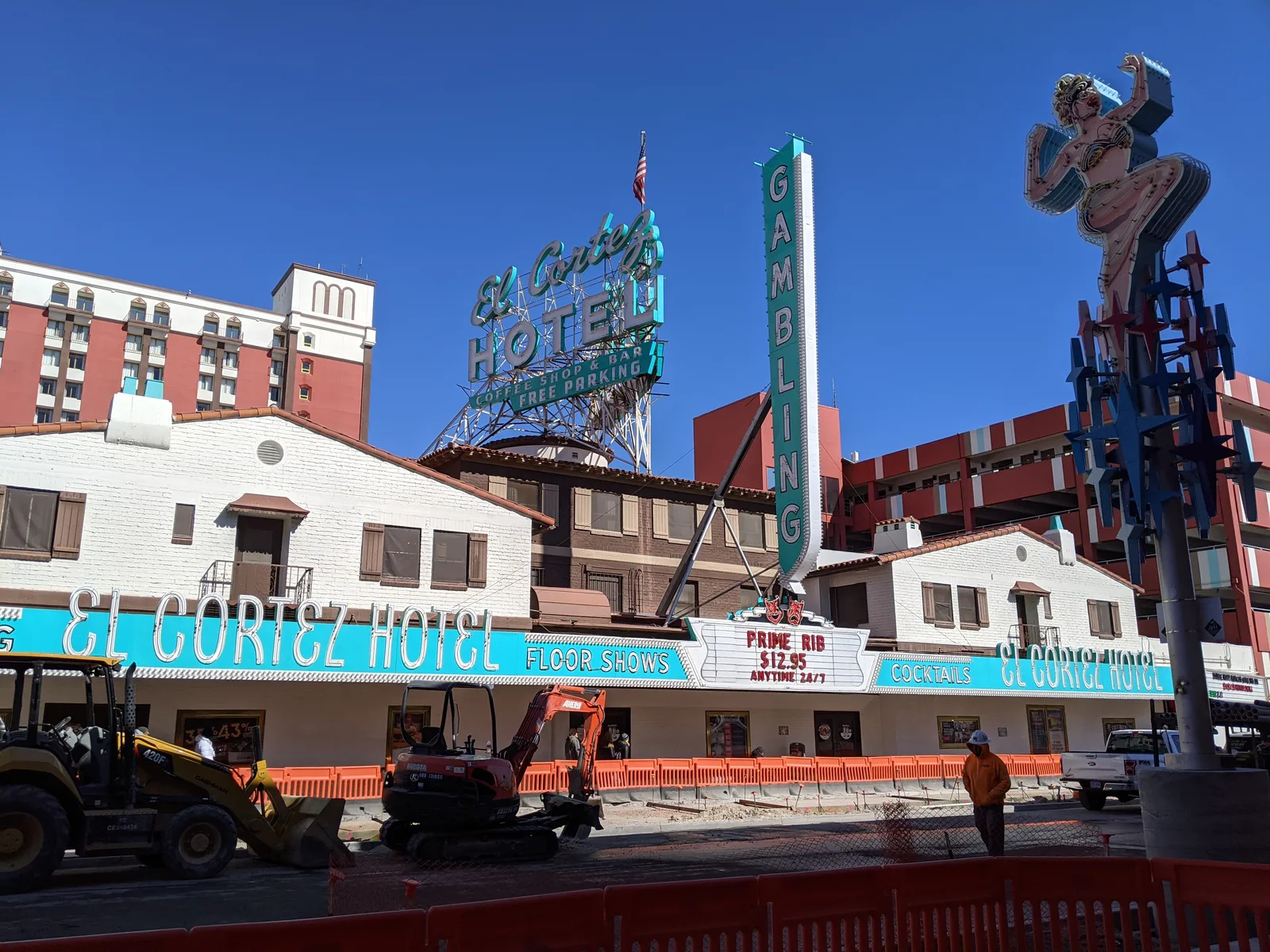

El Cortez opened on Fremont Street in 1941, when Downtown was still the centre of Las Vegas's hotel and casino business. Unlike the demolished resorts remembered through replacement sites, its historic building remains part of the working property at 600 Fremont Street. The National Register nomination describes the original hotel and casino as a visible link to Fremont Street's growth between 1941 and the early 1950s, when the expanding Strip began to overshadow Downtown.
The 1952 remodelling
The building is not an untouched time capsule. Its Spanish Colonial Revival forms were remodelled, extended and combined with later hotel and parking structures. The 1952 changes are particularly important: the exterior, marquee and neon signage were updated, and the casino was rearranged inside. The nomination attributes the exterior work to Zick and Sharp and the interior treatment to Tom Douglas.
What looks like an old Las Vegas frontage is therefore evidence of more than one period. Its historic character includes a mid-century reinvention, rather than depending on every visible feature dating from opening night. The property entered the National Register of Historic Places on February 13, 2013.
Ownership through the decades
El Cortez's ownership history connects several different versions of Las Vegas. Moe Sedway and his associates acquired it in 1945; J. Kell Houssels and Ray Salmon took over management in 1946, with the nomination distinguishing that step from the later legal transfer.
Jackie Gaughan: why sources give two dates
Jackie Gaughan's group acquired the property in the early 1960s and made it a lasting centre of his Downtown business. Sources that give 1962 and 1963 need not describe different purchases: the nomination quotes a November 1962 report of the transaction, pending gaming approval, with the new ownership effective January 1. The operator's history uses 1963.
Continued use and later renovations
Gaughan sold his interest in 2008, but the hotel's subsequent story has also involved alteration and continued use. The operator records refurbishment of the original rooms above the casino in 2022; its construction contractor reports completing another renovation and expansion in 2025.
These changes make El Cortez especially useful for reading the city as layers of fabric, ownership and use. Compare the older low-rise frontage with the later parts of the complex, and read the neon as a historical alteration in its own right. National Register recognition identifies a historic resource and its significance; it does not mean the entire present-day resort was built in 1941, or that the interiors have remained unchanged. The connected Vegas Retold Story offers a human-scale way into that wider history without requiring every episode associated with the name to belong to the same room or generation of the building.