Skip to content
Vegas Retold

The history of Dunes Hotel and Casino

Opened 1955 Closed January 1993

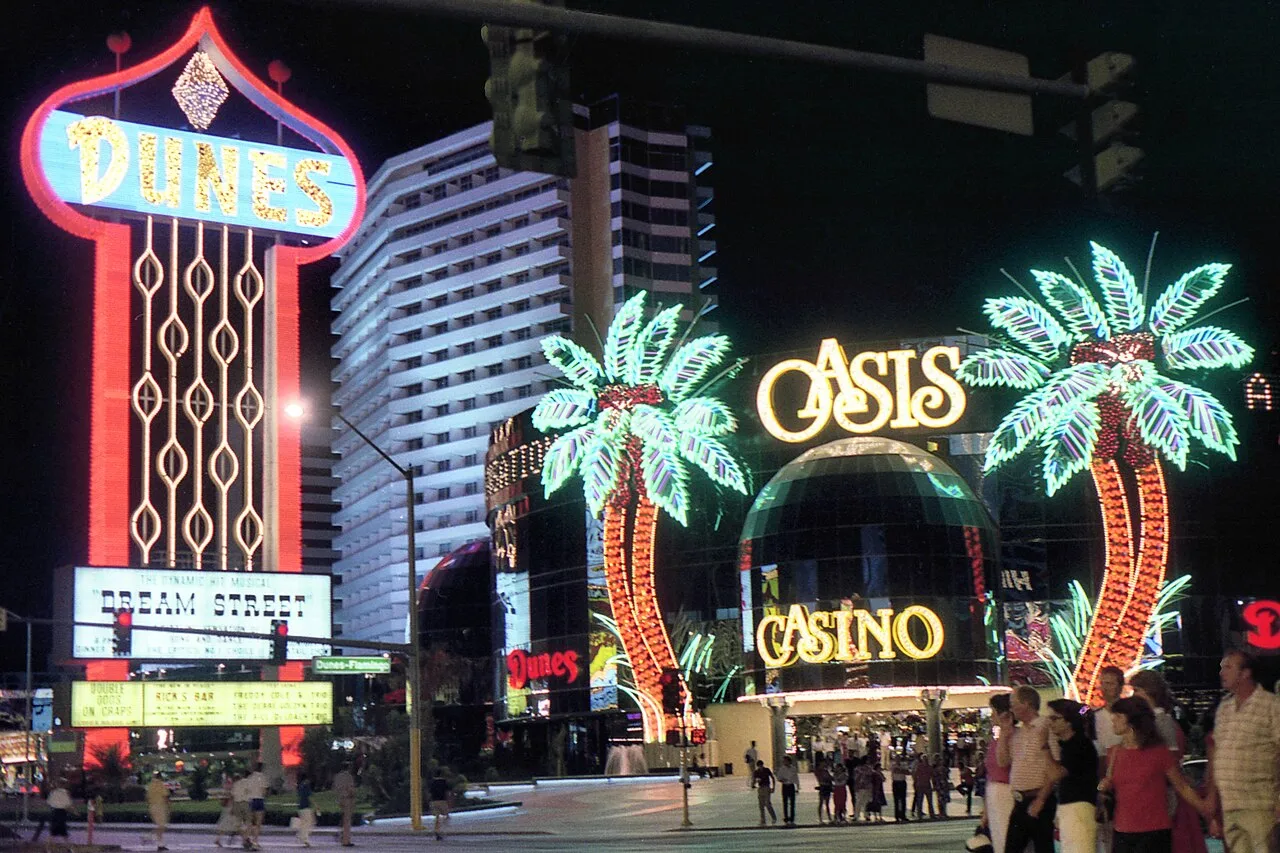
Illuminated Dunes pylon and hotel tower beside Oasis Casino’s round frontage and neon palm trees at night.
Dunes tower and pylon beside the Oasis Casino frontage in July 1983. These buildings and the tall sign were later demolished.

Larry D. Moore / Wikimedia Commons, CC BY 4.0

Image source· License

Resized from original photograph; responsive overview and index displays may crop presentation. No editorial alteration.

Dunes opened on the Las Vegas Strip in 1955 with an Arabian Nights identity and a giant fiberglass sultan above its entrance. The figure later moved to the rear of the property, facing the freeway. That changing landmark was only one part of a resort whose buildings, entertainment and fortunes developed over nearly four decades.

A difficult start and a growing entertainment business

The early business struggled. UNLV’s historical account describes the owners turning to the Sands management team in 1956 and a period when Dunes operated as a motel. Under Major Arteburn Riddle, entertainment helped establish a more durable identity. Minsky’s Follies arrived in 1957; Frederic Apcar later staged Vive Les Girls and the larger Casino de Paris production.

Restaurants and a larger hotel

Dining and accommodation also changed the property. The Sultan’s Table opened in 1961, while a high-rise addition followed in 1965. The Dome of the Sea offered a restaurant setting around a large aquarium. These were successive additions to the Dunes, rather than features of an unchanged opening-day hotel.

Closure before demolition

The resort closed in January 1993 after Steve Wynn acquired it. Sources disagree about the exact final day: contemporary Nevada Magazine reported January 25, while a later Neon Museum account describes January 26’s closing celebrations. The month is secure; closure should also be kept separate from the much later demolition spectacle.

The 1993 implosion and Bellagio replacement

On October 27, 1993, the north tower and tall roadside pylon were imploded in a production tied to the opening of Wynn’s Treasure Island. That blast removed major landmarks, rather than every piece of the resort in a single moment. UNLV’s account carefully describes the destruction of much of the Dunes. Bellagio eventually opened on the redeveloped site in October 1998.

A surviving sign at The Neon Museum

A smaller Dunes Entrance sign survived separately from the famous pylon. The Neon Museum acquired it in 2002 and later restored it. The museum’s object record dates restoration work to 2025; its September 2026 account reports the sign illuminated again. The preserved sign is therefore an off-site fragment, not evidence that the old casino still stands beside the Strip.

Reading the former site

The 1983 photograph shows the hotel tower, Dunes pylon and Oasis Casino frontage together. It records a later phase of the property. The map identifies the approximate former resort vicinity, where Bellagio now stands, rather than the museum collection or a surviving Dunes entrance.

  1. UNLV: Dunes Hotel and Casino Records, MS-00328

  2. The Neon Museum: The Dunes’ Dramatic Demolition

  3. Nevada Magazine: June1993 casino notes

  4. The Neon Museum: Dunes Entrance restoration facts

  5. The Neon Museum: History Behind the Sign, September2026

  6. MGM Resorts: Bellagio historical FAQ

  7. Mapcarta / GeoNames: Dunes former-site vicinity

  8. Wikimedia Commons: Dunes at night in1983

What remains uncertain

  • Sources differ on the exact January 1993 closure day; the date field retains the month.
  • The October 1993 implosion destroyed major portions of the resort. This history does not assert that every structure disappeared that night.
  • The Dunes Entrance sign survives in a museum. The former hotel and casino do not survive as Bellagio.

This site through time

Replaced by Park MGM (formerly Monte Carlo)

1996

Monte Carlo opened in 1996 on a portion of the former Dunes grounds and later became Park MGM through renovation and a name change. Bellagio occupies another part of the former Dunes site. Park MGM does not reuse the old Dunes hotel tower, and the two properties do not have identical footprints.

Historical source — UNLV MGM Mirage Records on Mandalay Resort Group, MS-00511, Historical Note: Monte Carlo opened in 1996 on the former Dunes site. Mary Manning, Las Vegas Sun, January 25, 2008, More about the Monte Carlo, independently identifies a portion of former Dunes grounds (indexed body read; direct reader returned 403). MGM’s May 9, 2018 release establishes the continuing Monte Carlo–Park MGM renovation and rename.

  • The relationship describes partial reuse of larger former Dunes grounds, not a surveyed overlap of the original hotel/casino buildings or an identical parcel.
  • 1996 is Monte Carlo’s opening year, not the date every Dunes building was demolished or all later redevelopment completed.

Replaced by Bellagio

1993 – 1998

Dunes closed in January 1993. Its north tower and tall pylon were imploded that October as the property was cleared for Steve Wynn’s Bellagio project. Bellagio construction began in 1996 and the new resort opened October 15, 1998. This is a replacement on redeveloped resort grounds, rather than a rename or a claim that Bellagio preserves the Dunes buildings. The earlier property also occupied a larger and changing site, including golf grounds.

Historical source — UNLV Dunes Hotel and Casino Records MS-00328, historical note: October 1993 implosion of much of the property and October 1998 Bellagio opening on the site. Corroboration: The Neon Museum’s Dunes Entrance record and demolition history; MGM’s Bellagio FAQ dates May 1996 construction and October 15, 1998 opening. Linked property histories list the sources and the closure-day uncertainty.

  • The year range marks the redevelopment interval, not either property’s complete operating dates.
  • Sources differ about the exact January 1993 closure day. The October implosion is a separate event, and is not asserted to have removed every structure.
  • The historical hotel, casino and golf grounds did not share an identical footprint with Bellagio’s present main hotel building.
Suggest a correction or source