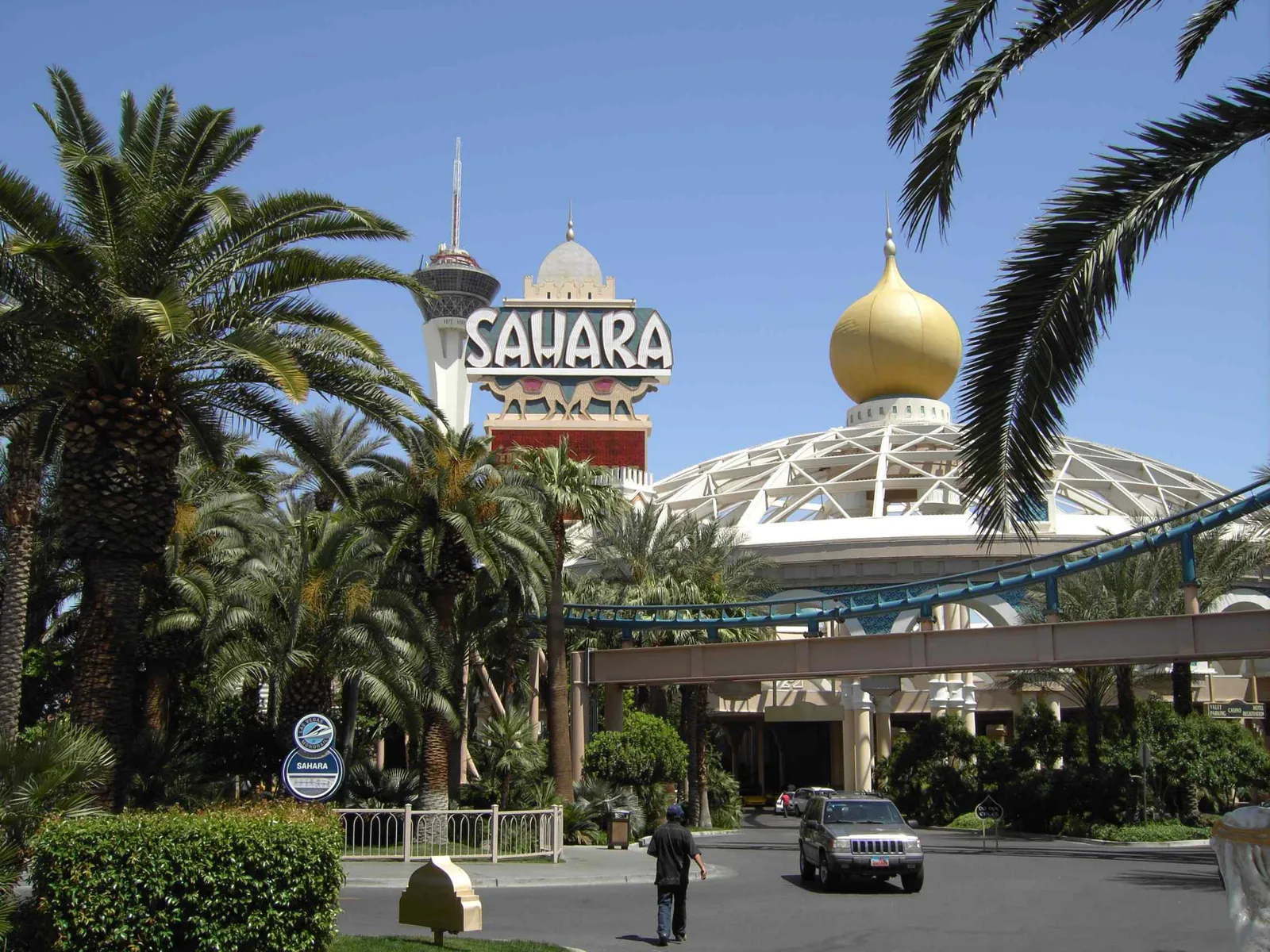
Later-site context: Sahara’s entrance in May 2006, more than fifty years after Club Bingo was replaced. This photograph does not show Club Bingo or its original buildings. The Stratosphere tower behind is a separate property.
Johnwalton at English Wikipedia / Wikimedia Commons, CC BY-SA 3.0
Original source photograph retained without editorial alteration. Responsive displays may resize and crop the presentation.
Club Bingo opened in 1947 on the future Sahara grounds. A small casino beside the Bonanza Room, it preceded the much larger hotel-casino built here in 1952. Its story belongs to the early Strip, before the Sahara’s towers and later name changes.
The casino before the resort
UNLV’s photographic records identify Club Bingo at 2535 Las Vegas Boulevard South, beside the Bonanza Room in the late 1940s and early 1950s. The combination of a casino and a named entertainment room helps explain a roadside business that preceded the much larger resort. These records identify the former premises; they do not establish which parts of the old structure, if any, survived redevelopment.
Milton Prell connects the two businesses in UNLV’s architectural account, which credits him with the Sahara development. A later Las Vegas Advisor investigation gives Mel D. Close as Club Bingo’s earlier owner and places Prell’s purchase in 1952. Those accounts differ on the ownership sequence, so this history does not assign an exact founding partnership or purchase date.
One name, two different casinos
The name needs particular care. A different Club Bingo opened at 23 East Fremont Street in 1962 and was later absorbed into the neighboring Pioneer Club. That Downtown business was not the Strip casino and did not become the Sahara. Its later opening and closure dates should not be attached to this site.
Reading the later site
The Sahara subsequently expanded through hotel towers, changing signs and further redevelopment. Those later changes belong to the successor resort’s history. The historical photograph records the Sahara entrance in May 2006, not Club Bingo in operation. The former casino’s building footprint has not been established closely enough to mark an original doorway or a surviving wall.
UNLV Skyline, opening historical paragraph and Sahara timeline: 1947 casino, Prell and 1952 successor. Subsequent towers belong to Sahara, not Club Bingo.
UNLV sky000140, description/date/address: 1947–1952, Club Bingo with Bonanza Room, replaced by Sahara in 1952, 2535 Las Vegas Boulevard South. Catalog text read; original photograph not downloaded or licensed for this page.
UNLV sky000209, date and description/address: Club Bingo on the Strip, 1947–1952, 2535 Las Vegas Boulevard South. Catalog evidence does not establish an exact historical footprint; original image not reproduced.
September 18, 2005 investigation, paragraphs distinguishing the original Strip casino from the 1962 Downtown business at 23 East Fremont and its Pioneer Club absorption. Earlier ownership differs from UNLV’s synthesis; exact founding owner and purchase date are unselected. Demolition detail remains uncertain.
Sahara location 36.142275,-115.156245, rounded to four decimals for a representative former-site vicinity. This is not a survey of Club Bingo buildings; unrelated Thunderbird coordinates in the collection map are not adopted.
Johnwalton’s photograph, described as taken in May 2006. May 20 is the original upload date, not a verified day of photography. Transferred from English Wikipedia to Commons; CC BY-SA 3.0 selected from the file’s licensing options.
What remains uncertain
Sources differ on the original ownership sequence and on how much of Club Bingo’s building was retained in the Sahara development. No complete demolition or precise retained footprint is asserted.
Opening and closure are recorded at year precision. The later Downtown Club Bingo has separate dates and a separate site.
The map is a representative point within the later Sahara grounds, not verified original casino walls, an entrance or a walking route.
No rights-cleared Club Bingo-period image has been selected. The dated 2006 Sahara photograph is explicitly later-site context; UNLV’s historical photographs are cited as evidence, not reproduced under an assumed licence.
The Sahara hotel-casino replaced Club Bingo and the Bonanza Room on these grounds in 1952. This was the development of a larger resort, rather than simply a new name for Club Bingo. The precise extent of demolition or retained buildings has not been established. Later Sahara/SLS name changes belong to the successor resort.
Historical source — UNLV sky000140, date/address/description: Club Bingo and Bonanza Room, 1947–1952, 2535 Las Vegas Boulevard South, replaced by Sahara in 1952. UNLV Skyline Sahara narrative independently identifies the former site.
This relationship identifies redevelopment at the same site; it does not assert that every Club Bingo building was demolished or that the historical and current resort boundaries coincide.