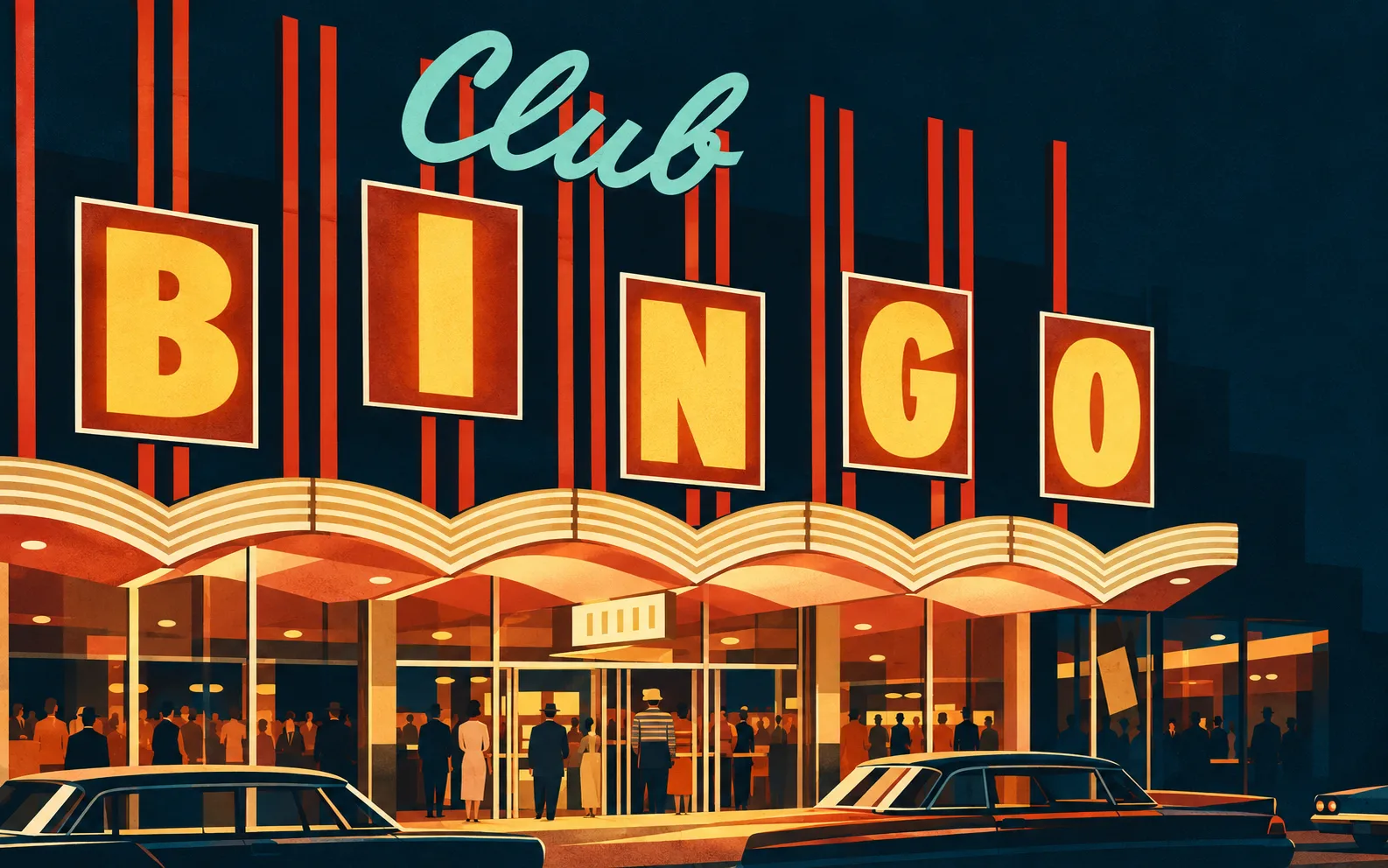
AI-generated flat geometric editorial illustration; architectural details simplified. Not an archival photograph.
Five separate BINGO panels above a scalloped canopy made Downtown Club Bingo a recognizable Fremont Street frontage. A surviving postcard identifies the address as 23 Fremont Street and promotes bingo, snacks and cocktails. The image accompanying this page is a modern illustration adapted from that historical view.
This Club Bingo operated from 1962 to 1983. It occupied premises previously used by the Westerner and, before that, the Las Vegas Club, which had moved across Fremont Street. In 1983 the neighboring Pioneer Club expanded into the Club Bingo location.
Club Bingo helps distinguish a casino business from the premises it occupied. The Las Vegas Club moved; the address acquired another name and another gaming identity. UNLV preserves a 1978 building-survey record for Club Bingo at 23 Fremont Street, while the postcard preserves its distinctive signs and street-facing canopy.
It was a separate Downtown venue from the Club Bingo that preceded the Sahara on the Strip. Sharing a name does not make the two casinos the same Property.
Cardboard America postcard scan and transcribed reverse, address and bingo/snacks/cocktails description. Mailing January 1966 is not a photograph date.
Page 13, Club Bingo, 23 Fremont St., 1978; Harvey Harris survey, box 03. Catalog record establishes named address and survey date; full survey not inspected.
Casino Chip and Token News, Fall 2006, pp33–34: Las Vegas Club moved across street in 1949; Westerner at former location; Club Bingo 1962–1983 and Pioneer expansion in 1983.
Historical investigation distinguishes Strip and Downtown casinos; Downtown address 23 E Fremont, 1962 opening, earlier Westerner/Las Vegas Club premises, Pioneer expansion and 1983 closure. Exact days not adopted.
What remains uncertain
Operating years are given at year precision from historical accounts; exact opening and closure days are not selected here.
The matching postcard was mailed in January 1966; its postmark does not establish the date of the photograph.
No precise historical parcel or surviving-fabric boundary is asserted.