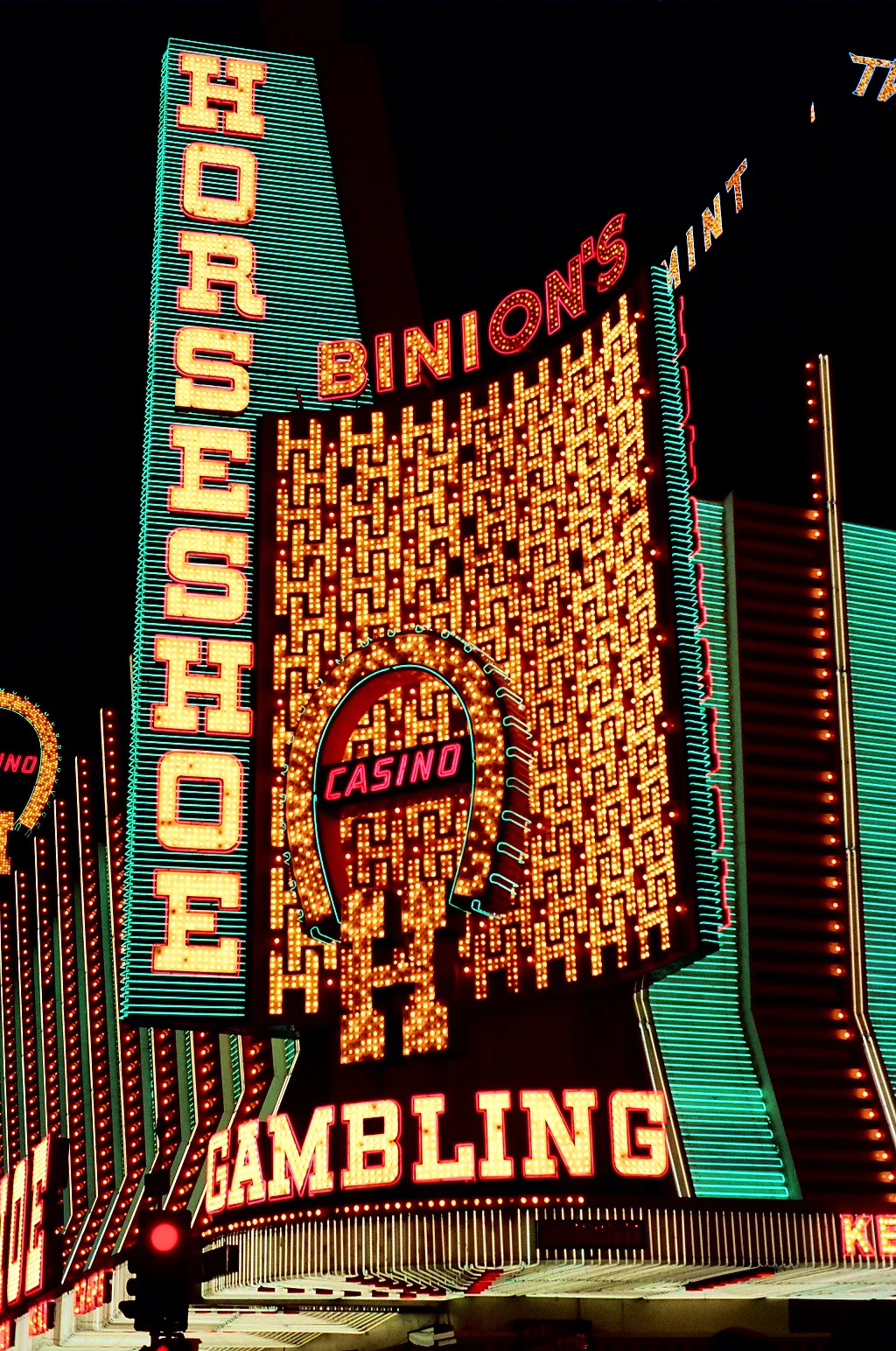

Benny Binion bought the Eldorado Club on Fremont Street in 1951 and renamed it the Horseshoe Club. The casino that became Binion's began by taking over an existing gambling property. UNLV's collection history records a period of majority ownership by Joe W. Brown after Binion's 1953 tax-evasion conviction, followed by Binion regaining ownership. By 1964 the business was known as Binion's Horseshoe.
A complex assembled from neighbouring sites
The site expanded as neighbouring properties were incorporated. The operator records the purchase of the Boulder Club in 1960 and the later acquisition of the Mint by Benny Binion's sons. Sources differ over the Mint transaction's year: the operator uses 1988, while a World Series of Poker retrospective uses 1987. The broader sequence is clear: the late-1980s expansion made a larger complex out of several downtown sites, so the current footprint should not be projected back onto the original Horseshoe.
Poker before the tournament boom
Poker gave the place an identity beyond its frontage. The first World Series of Poker was held at the Horseshoe in 1970. The event's own history describes seven invited players playing cash games, with Johnny Moss selected by a vote. That beginning differs from the large elimination tournaments the name later came to represent.
The property, the name and the tournament
Ownership of a casino and ownership of its name could also separate. MTR Gaming's financial filings record its 2004 acquisition of the property, with Harrah's acting as the interim operator. Harrah's retained the Horseshoe and World Series of Poker rights. MTR took over operations in March 2005 and renamed the business Binion's Gambling Hall & Hotel. The bulk of the 2005 WSOP moved to the Rio, although the Main Event's concluding play returned downtown for a final farewell.
The hotel closure and the Apache return
TLC Casino Enterprises bought the property in March 2008, according to the operator. In December 2009 its hotel rooms closed while the casino continued operating. Accommodation acquired a different shape in 2019, when Binion's announced an 81-room Hotel Apache opening under the historic hotel's name. The Apache's origins reach back to 1932, before the Horseshoe. This was a renewed hotel offering within the existing complex, rather than a new casino replacing Binion's.
The current operator presents both the gambling hall and Hotel Apache at 128 East Fremont Street. The mapped point identifies the expanded casino area. It does not identify an entrance, the precise boundary of any earlier casino or the location of a relocated sign. The Eldorado, Boulder Club, Mint and Apache layers each deserve their own evidence and identity; sharing part of today's complex does not make their histories interchangeable.